‏إظهار الرسائل ذات التسميات Wild Nature. إظهار كافة الرسائل

السبت، 5 سبتمبر 2015

Closure on K2: Video prompts Texas woman's journey to Pakistan slope to find bodies of father, brother


A grim warning underscored by a haunting image from the world’s second-tallest mountain left one viewer of adventurer Mike Horn’s slick Facebook videodumbstruck – and launched her recent quest for closure for herself and others whose loved ones died trying to scale the treacherous peak.
“If you are not 100 percent ready, the mountain is going to kill you,” Horn, an internationally known sportsman and motivational speaker, intoned as a stylized ax sliced dramatically through the northern Pakistan mountain and the camera lingered briefly on a partially preserved head lying on a glacier.
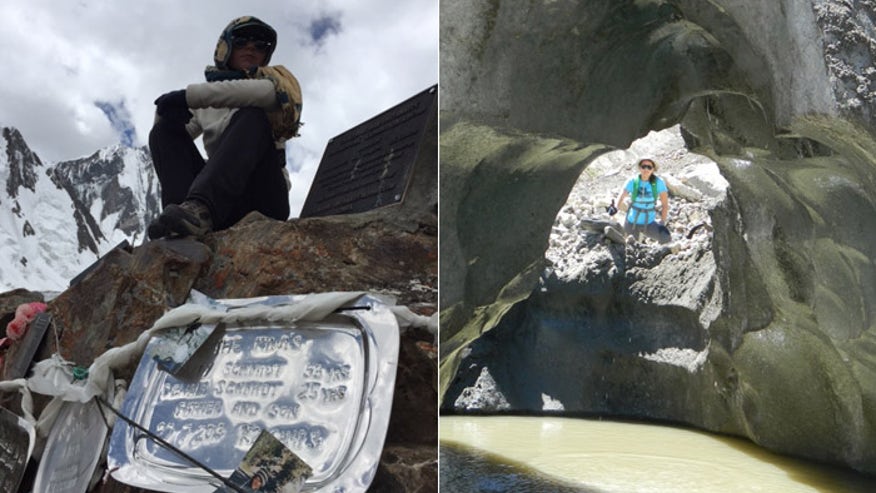
For Sequoia Di Angelo, 24, of Houston, the image on the video posted in July was almost too much to bear. Two years ago, her father and brother died on the mountain and their bodies were never recovered.
“I immediately thought, ‘Oh my God, that’s my brother’s head,’” Di Angelo toldFoxNews.com. “I’m sure every family who lost someone on that mountain thought the same thing and experienced the same sick feeling in seeing that.”
“I immediately thought, ‘Oh my God, that’s my brother’s head.’”
- Sequoia Di Angelo
Di Angelo’s father, Marty Schmidt, 53, and her brother, Denali, both experienced climbers, died in an avalanche on July 26, 2013, while trying to become the first father-son team to successfully scale the 28,251-foot peak. K2, on the China border, may not be as tall as Mount Everest, but while 4,000 have conquered Everest, just 377 have seen the top of K2. The avalanche added the Schmidts to a roster of at least 82 who have died trying to reach the summit.
The trip by Horn, who has performed a string of “extreme adventure” feats, including a solo circumnavigation of the Arctic Circle and a journey to the North Pole with without the aid of dogs or machines, was sponsored by Mercedes-Benz. The fact that it was scuttled due to harsh weather is testament to K2’s dominance of man, but the image that shocked Di Angelo bothered others, as well.
Read More ->>

الجمعة، 4 سبتمبر 2015

Ants are safer, more effective than pesticides, study says


There’s a new ant–agonist on the pesticide market. According to a reviewpublished in the Journal of Applied Ecology, trees protected by weaver ants have less pests, less plant damage, and show an increased yield when compared to trees sprayed with pesticides. The small, red tree dwellers are also cheaper to use and better for the environment.
What makes the weaver ants so effective is their ability to quickly respond and attack larger intruders. They’re categorized as a “superorganism,” which means that the colony functions like one organism, with individual ants acting as its cells and moving around independently. When an intruder enters their environment, the ants coordinate attacks via pheromones before taking the insect back to their nests of woven leaves to feed the colony. With the crops hanging so close to the nests, they fall under the ants’ protection.
To put together his review, Aarhus University bioscience professor Joachim Offenberg pored over approximately 70 recent scientific studies on the use of ants as pest control on nine different crops against various pests in Africa, Australia, and Southeast Asia. One three–year Australian study revealed a 49 percent higher cashew yield in ant–protected trees versus those sprayed with pesticide. Not only that, but the cashews were of a significantly higher quality. Likewise, mango trees protected by ants produced a better quality crop. This, coupled with the ants being cheaper than pesticide, resulted in a 73 percent higher net income.

That’s not to say that similar results were reported across the board.
“There do exist a few cases where the ants alone are not the solution as some pests have adapted and can protect themselves against them,” Offenberg told Foxnews.com. “In these cases, the ants need to be supplemented with other control methods to obtain adequate control. This is called integrated pest management (IPM), when different methods are combined in the same agricultural system.”
Read More ->>

Study finds more sharks than ever swimming in waters along the East Coast


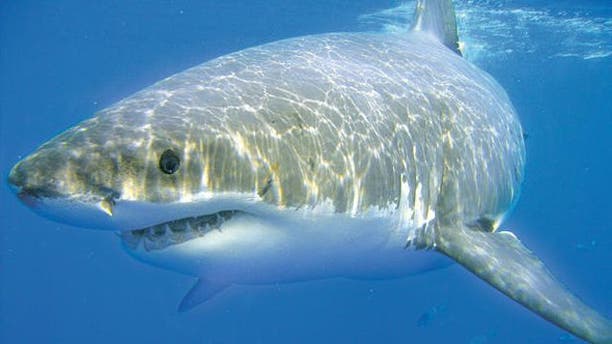
More sharks than ever are swimming along the East Coast, federal researchers announced this week, amid a busy summer in which a record number of the fish have attacked North Carolina beachgoers.
Scientists with the National Oceanographic Atmospheric Administration (NOAA) captured and tagged 2,835 sharks in waters from Florida to North Carolina in 2015, up from 1,831 in 2012 -- the last year the survey was completed. Scientists recorded the length, sex, age and location of each of the sharks caught. The survey has been ongoing for 29 years.
Lisa Natanson, a scientist at the Narragansett Laboratory of NOAA Fisheries’ Northeast Fisheries Science Center (NEFSC) and leader of the coastal shark survey, told FoxNews.com that the rise in the shark population is tied to federal regulations limiting commercial shark fishing, which were enacted in 1993.
“They took off a lot of fishing pressure of these species and it gives them a chance to come back,” Natanson said.
The survey – conducted every two to three years -- covers routes along the East Coast where many species migrate as waters become warmer, making it easier to keep tabs on the population, according to the NOAA.
Sandbar, Atlantic sharpnose, dusky, and tiger sharks were the most common amongst the 13 species caught this year onboard the 100-foot charter fishing vessel Eagle Eye II, which set sail from Port Royal, S.C. and  Ft. Pierce, Fla., from April to May.
Natanson told FoxNews.com that researchers – who used a line with baited shark hooks to catch the fish -- saw an uptick in numbers in waters off Florida.
“Usually we get a few here and there on the first few sets,” she said. “But we were getting a lot.”
The announcement comes in the wake of a string of shark attacks in North Carolina in June and July. Eight people were attacked -- the most in a year in since the Florida Museum of Natural History began tracking shark incidents 80 years ago. The previous high for North Carolina was five bites in 2010, The Virginian Pilot reported.
Despite the increased shark population, Natanson said beachgoers should not assume that there will be a rise in attacks, although “there is always going to be a risk.
“Just because there are a lot of sharks out there doesn’t mean there are going to be more coming in to bite people,” she told FoxNews.com, adding that the survey was conducted in areas where people were not swimming.
Around 2,179 of the sharks captured in the survey were tagged and released, 434 were brought aboard, and 222 were released untagged. The sharks that did not survive capture were dissected at sea to obtain biological samples for studies on shark age and growth, reproduction, and food habits, the NOAA said.
Read More ->>

المساهمون

يتم التشغيل بواسطة Blogger.