الخميس، 10 سبتمبر 2015

Amateur paleontologist unearths rare fossil of fish in Arizona


An amateur paleontologist may have made the discovery of the summer last month when she found a jaw bone belonging to a long-snouted fish known to exist more than 220 million years ago.
Stephanie Leco was part of the first dig for citizens held last month at at Arizona’s Petrified Forest National Park. The park routinely turns up fossils from the age of the dinosaurs and has vast expanses of rainbow-colored desert.
The fossil is about the same size of a pinky fingernail. It was unearthed from the site of what was a lake or pond in the Late Triassic period, when the fish were thought to be extinct in North America. Scientists knew closely related fish were present in the world in the Early Triassic period, about 10 million years earlier, but the fossils were found only in China in the Late Triassic, said park paleontologist Bill Parker.
"People who actually study this group of fish might start setting their sights in our direction now," he said.
Leco was sifting through loose dirt on a barren hillside using her background in art to differentiate colors, patterns and textures among bones, rocks and charcoal when she targeted an area looking for smaller objects. She already had several small teeth in her collection and was marveling at the tibia of a plant lizard that another digger found before coming across the jaw bone. Not exactly sure what it was, she handed the fossil over to Matt Smith, the park’s lead fossil preparer, and asked what it was.
"I don't know, that's why it's cool," he responded.
The two wrapped the bone, placed it in a tin and took it to the lab, looking at it more closely under a microscope, she said. The park later emailed her to say it was a fish closely related to the genus Saurichthys.
"Okay, it wasn't a T-Rex," Leco, a Phoenix resident, wrote in an email to The Associated Press. "But, honestly, I feel like this is much cooler!"
The 26-year-old said she’s since developed an even deeper fascination with paleontology and bought a couple of books on the Triassic period so that she can speak with authority about her find. The period, which started about 250 million years ago and lasted 50 million years, followed the largest extinction of life on Earth when the land mass was a single continent and had the first dinosaurs.
The full jaw of the fish would be about three to four times longer than the fossil Leco discovered, Parker said. He said other fossils of the fish might also be found on the East Coast and on the Colorado Plateau where similar rock is exposed.
Ben Kligman, a senior at the University of California, Berkley, has been studying the pond site preserved in a six-inch layer of rock. He plans to return to Petrified Forest next summer to look for a full fossil of the fish to determine whether or not it's a new species. What he didn't know before Leco found the jaw bone is that he already had smaller pieces of the fish that he couldn't identify as such, he said.
"Although it's probably a new species, we can't say that it is yet because we don't have enough specimens," Kligman said.
Other citizens participating in the August digs found the vertebrae of a long-necked lizard first uncovered in the park last year and the teeth of a large carnivorous reptile, both considered rare in the park's fossil record. Their names will accompany the collections at the park, which will use them to reconstruct the habitat of the pond and get a better idea of where the animals fell in the food chain, Parker said.
"Anytime we can fill in gaps in the fossil record, it's really important," he said. "People who don't study Triassic fish may not be excited. The fact you can find new stuff is the real takeaway."
The Associated Press contributed to this report.
Read More ->>

الأربعاء، 9 سبتمبر 2015

European astronaut uses 'the Force' to control rover from space


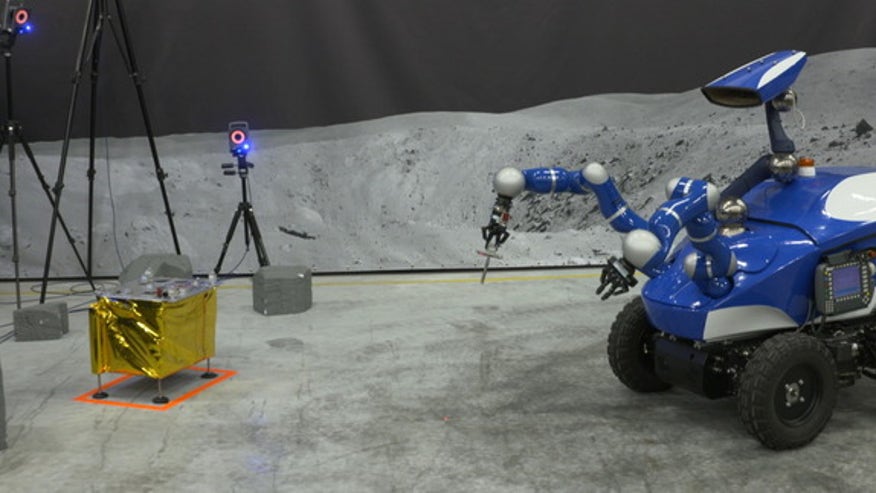
Demonstrating one small step for rover operations, a European astronaut successfully maneuvered a machine on Earth in precision operations from his perch 248 miles high on the International Space Station.
Sept. 7, the European Space Agency (ESA) astronaut Andreas Mogensen helped demonstrate the first "force feedback" using a rover controlled from space. With the help of a system that let him feel forces pressing against the rover's arm, Mogensen remotely inserted a small, round peg into a "task board" that offered just a fraction of a millimeter of clearance.
"Andreas managed two complete drive, approach, park and peg-in-hole insertions, demonstrating precision force-feedback from orbit for the very first time in the history of spaceflight," experiment leader André Schiele of ESA's Telerobotics and Haptics Laboratory said in a statement. [Video: Space-Borne Astronaut Runs Robot On Earth]
"He had never operated the rover before, but its controls turned out to be very intuitive," Schiele said in the statement. "Andreas took 45 minutes to reach the task board and then insert the pin on his first attempt, and less than 10 minutes on his follow-up attempt, showing a very steep learning curve."
Clever engineering allowed the astronaut to "feel" his way around the hole despite there being a 1-second delay between his movements and what was happening on the ground. The team — which included members from the European Space Research and Technology Centre (ESTEC) and graduate students from Delft University of Technology, both in the Netherlands — created software models to compensate for the lag.
The signal from the space station has to pass through several obstacles before reaching ESTEC and the waiting rover. After leaving the station, the signal goes to satellites in geosynchronous orbit roughly 22,300 miles high, beams to a ground station in New Mexico (via NASA's Johnson Space Center) and then travels to ESTEC via a transatlantic cable. 
By the time the signal gets back from the International Space Station, the round-trip is more than 89,000 miles, the equivalent of nearly halfway to the moon.
Besides placing a peg in a hole, Mogensen also evaluated the stiffness of different springs on the joystick to figure out the appropriate sensitivity for the device. 
The experiment, called Interact, is intended to pioneer remote-control operations from space. As astronauts expand exploration across the solar system, someday this technology could be used for lunar bases or exploring Mars, ESA officials added.
Read More ->>

الثلاثاء، 8 سبتمبر 2015

Space Station crosses Sun's face in spectacular new photo


An amazing new photo shows the International Space Station crossing the sun's face.
The picture, a composite of five images taken Sept. 6 from Shenandoah National Park in Virginia by NASA photographer Bill Ingalls, captures a "transit" of theInternational Space Station (ISS) across the solar disk.
Such transits don't last very long, because the space station zooms around Earth at more than 17,000 mph — the $100 billion complex completes one lap around our planet once every 90 minutes or so.
Transits can offer more than just aesthetic appeal. For example, in the 18th century, astronomers were able to calculate the distance from the Earth to the sun by carefully observing two transits of Venus across the sun's face (one in 1761 and the other in 1769) from various locations around the globe. And NASA's Kepler space telescope has spotted thousands of potential exoplanets by detecting the tiny brightness dips they cause when crossing in front of their stars from the observatory's perspective.
The ISS is currently staffed by nine space fliers. But three of them — cosmonaut Gennady Padalka, Denmark's Andreas Mogensen and Kazakhstan's Aidyn Aimbetov — will come back to Earth Saturday (Sept. 12), returning the orbiting lab to its normal complement of six crewmembers.
Read More ->>

Elon Musk's answer to making Mars more like Earth? Just nuke it


It hasn't even been a week since Stephen Colbert started hosting CBS' The Late Show, and already, he's getting his guests to make some pretty spectacular claims. Oprah may have watched Tom Cruise jump on a couch, but Colbert got Elon Musk to advance a decidedly gasp-worthy theory about how best to make Mars a more hospitable environment for human life. "The fast way is to drop nuclear weapons over the poles," the Tesla, SpaceX, and PayPal founder told Colbert. To which the host responded, "You're a supervillain!"
Or Ironman, but you know, same difference.
Describing Mars as "a fixer upper of a planet," Musk noted that the main problem with our red neighbor is that it's too cold for inhabitation. But, he noted, it can be made to more closely resemble Earth if we just warm it up. "There's the fast way and the slow way," Musk said, with the slow way being the gradual release of greenhouse gasses, which are famous on Earth for causing global warming and climate change.
But the flashier, more exciting way (and let's face it, the more Elon Musk way), is to drop nuclear bombs on the planet, because nothing screams warmth like thermonuclear weapons. Unfortunately, Musk didn't get to elaborate much further on how exactly this plan would pan out, but it's certainly a novel idea. And considering that his last few SpaceX rocket landings have resulted in explosions of their own, maybe Musk can jumpstart this warming process by sending his spacecraft to Mars.
Of course, the viability of such a plan is probably a bit more questionable than say, bringing frozen methane to Mars from neighboring planets or moons, or better yet, bringing cyanobacteria and algae that are capable of producing oxygen to the Red Planet. But then again, many of Musk's ideas have seemed outlandish at first blush, and he's only ever proved the haters wrong.
So keep this Late Show prediction in the back of your minds, folks. We may just be exploding nukes on Mars someday. Better there than here.
Read More ->>

Step inside Crew Dragon: SpaceX reveals interior of crewed space capsule


SpaceX has thrown open the hatch to its Crew Dragon spacecraft, revealing a sleek black and white interior for the capsule it is building to fly astronauts to the International Space Station and other destinations.
"Step inside Crew Dragon," SpaceX invited on a new page of its website on Sept. 10.
"Dragon made history in 2012 when it became the first commercial [uncrewed] spacecraft to deliver cargo to the space station," SpaceX wrote on its website. "But Dragon was also designed from the beginning to carry people, and today SpaceX is finalizing the necessary refinements to make that a reality." [Take a Video Tour Inside SpaceX's Crew Dragon Spacecraft]
Images and video newly-released by the company show that the tan leather and mirrored metal surfaces previously unveiled as part of Crew Dragon's debut in May 2014 have now been replaced by black bucket seats and stark white walls.
"Crew Dragon was designed to be an enjoyable ride. With four windows, passengers can take in views of Earth, the Moon, and the wider Solar System right from their seats, which are made from the highest-grade carbon fiber and Alcantara cloth," SpaceX described.
The spacecraft's only punch of color — other than from its windows — is from the flat panel displays of the capsule's forward-mounted control panel.
"Crew Dragon's displays will provide real-time information on the state of the spacecraft's capabilities, anything from Dragon's position in space, to possible destinations, to the environment on board," SpaceX stated.
The Crew Dragon's environmental control and life support system will "provide a comfortable and safe environment" for its passengers, added the Hawthorne, California-based company. "During their trip, astronauts on board can set the spacecraft's interior temperature to between 65 and 80 degrees Fahrenheit."
The fully autonomous Crew Dragon is one of two privately designed spacecraft NASA has contracted to begin flying its astronauts to the space station beginning in 2017. The other, Boeing's CST-100 Starliner, is also equipped with a primarily black and white cabin, punctuated by the glow of "Boeing Sky Interior" blue LED lighting, as the aerospace company has deployed on its passenger jetliners.
SpaceX, which earlier this year tested the Crew Dragon's emergency escape system, is planning another abort test in 2017, preceded by a test flight without astronauts to the space station. The company's first Crew Dragon to fly with NASA astronauts aboard will follow the in-flight abort test, prior to SpaceX starting to fly operational missions to the orbiting outpost in the next two to three years.
Read More ->>

الأحد، 6 سبتمبر 2015

North America's tallest mountain gets new name - and height


North America's tallest mountain doesn't just have a new name. It also has a new elevation.
Denali, the Alaska mountain formerly known Mount McKinley, is now officially 10 feet shorter, measuring 20,310 feet at its highest point, the U.S. Geological Survey announced Wednesday.
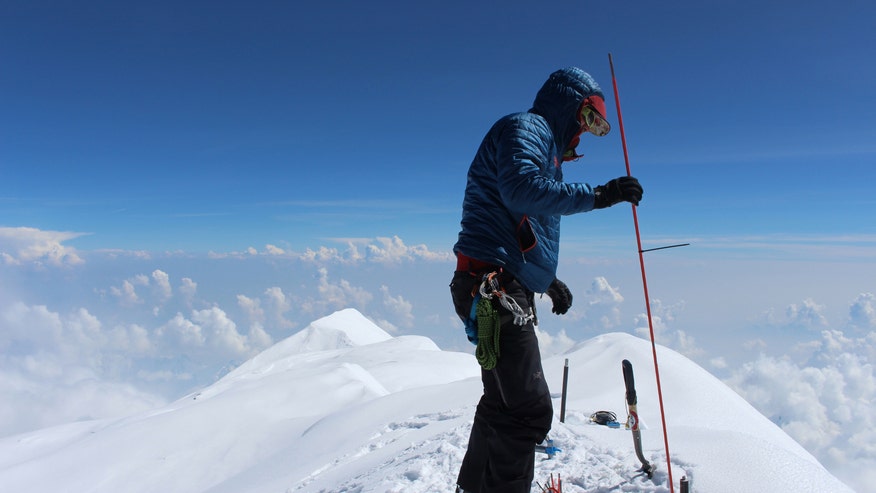
The previous measurement of 20,320 feet stemmed from a 1953 survey that used the technology of the time, officials said. The new elevation is the result of data collected from the mountain by climbers in June using technology that didn't exist in the earlier survey, such as GPS instruments.
The change is part of an ongoing USGS program to update elevations in Alaska and elsewhere. The agency has a program that uses radar to collect more elevations over large areas in Alaska, but the Denali survey was unusual because it involved actual ground measurements, said Kari Craun, director of the USGS National Geospatial Technical Operations Center.
"It's a very visible and important point for North America," she said.
The climb to gather the data from Denali began June 15 and involved one climber from the University of Alaska Fairbanks and three climbers from the private survey company CompassData Inc., USGS spokesman Mark Newell said. During their 14 days on the mountain, the climbers pulled equipment and supplies on sleds.
The change comes just days after the Obama administration announced its decision to bestow the traditional Alaska Native name to the mountain on the eve of president's visit to Alaska this week. The change to Denali— an Athabascan word meaning "the high one" — replaces the name that honored the 25th president, William McKinley, who never set foot in Alaska.
"We think this revised elevation, with a more precise measurement, is a fitting tribute to the name Denali," Newell said.
Known for its majestic views, the mountain is dotted with glaciers and covered at the top with snow year-round. Powerful winds make it difficult for the adventurous few who seek to climb it. Each year, about 1,200 climbers attempt to summit the mountain, with only about half actually succeeding.
Using GPS instruments for the latest measurement provided more defined elevations than technology that was used in 2013 to calculate a slightly lower elevation. The 2013 calculation put the mountain at 20,237 feet, but it was done with the aerial radar measurements that fall short in pinpointing exact elevations, Newell said.
Elevation measurements taken outside Alaska involve a different aerial-based technology that is considered more accurate, Craun said.
The raw data collected in June was analyzed and processed to determine the new elevation. Officials said researchers had to take certain factors into account, including the depth of the snowpack at the summit.
Read More ->>

This photo of Saturn's moon Dione crossing the planet is simply jaw-dropping


An icy moon of Saturn hangs against the face of its giant parent planet in a breathtaking new image captured by NASA's Cassini spacecraft.
The photo, which Cassini took on May 21, shows the moon Dione crossing Saturn's disk. Careful study of such "transits" can help astronomers better understand the orbits of Dione and other moons in the solar system, NASA officials said.
Furthermore, NASA's Kepler space telescope and some other instruments hunt for exoplanets by looking for tiny dips in a star's brightness caused by transiting alien worlds. Studying the light coming from such extrasolar systems can also reveal details about the composition of these exoplanets' atmospheres.
At 696 miles in diameter, Dione is the fourth-largest of Saturn's sixty-odd moons; only Titan, Rhea and Iapetus are bigger. Parts of Dione are heavily cratered, and the satellite's trailing side features mysterious ice cliffs and fractures that run for tens or hundreds of kilometers. Cassini has also detected a wispy oxygen atmosphere surrounding the frigid moon.
Cassini snapped the new photo, which was released Aug. 31, when the probe was about 1.4 million miles from Saturn. The image's resolution is 9 miles per pixel.
But Cassini has gotten much closer looks at Dione, thanks to a handful of flybys over the years. During the most recent one, which occurred Aug. 17, the spacecraft zoomed within just 295 miles of the moon's surface, returning a set of amazing images.
The Aug. 17 maneuver was the last scheduled up-close look at Dione, however; no more close flybys are planned before Cassini ends its mission with an intentional death dive into Saturn's thick atmosphere in September 2017.
The $3.2 billion Cassini mission, which launched in 1997 and arrived in the Saturn system in 2004, is a joint operation involving NASA, the European Space Agency and the Italian Space Agency.
Read More ->>

المساهمون

يتم التشغيل بواسطة Blogger.